Celebrations started at Dublin Castle when the results were announced
One of Ireland's most senior Catholic clerics has called for the Church to take a "reality check" following the country's overwhelming vote in favour of same-sex marriage.
The first gay marriages are now likely to take place in the early autumn.
Diarmuid Martin, the archbishop of Dublin, said the Church in Ireland needed to reconnect with young people.
The referendum found 62% were in favour of changing the constitution to allow gay and lesbian couples to marry.
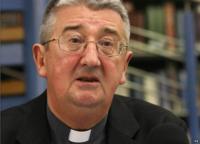
The archbishop voted 'No' in the referendum
The archbishop told the broadcaster RTE: "We [the Church] have to stop and have a reality check, not move into denial of the realities.
"We won't begin again with a sense of renewal, with a sense of denial.
source:bbc
"I appreciate how gay and lesbian men and women feel on this day. That they feel this is something that is enriching the way they live. I think it is a social revolution."
The archbishop personally voted "No" arguing that gay rights should be respected "without changing the definition of marriage".
"I ask myself, most of these young people who voted yes are products of our Catholic school system for 12 years. I'm saying there's a big challenge there to see how we get across the message of the Church," he added.
Ireland is the first country in the world to legalise same-sex marriage through a popular vote, and its referendum was held 22 years after homosexual acts were decriminalised in the Republic of Ireland.
Among those voicing their approval of the outcome was UK Prime Minister David Cameron who tweeted: "Congratulations to the people of Ireland, after voting for same-sex marriage, making clear you are equal if you are straight or gay."
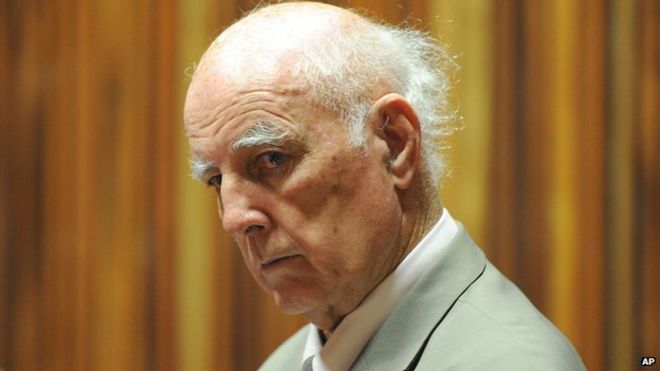
The judge criticised Bob Hewitt for his lack of remorse during the trial
Former Grand Slam tennis star Bob Hewitt has been jailed for six years by a South African court for raping underage girls.
Hewitt, 75, was found guilty in March of two counts of rape and one of sexual assault on girls he was coaching in the 1980s and 1990s.
Judge Bert Bam criticised the Australian-born player for not showing remorse during his trial.
He said justice must be seen to be done, even for ageing offenders.
One of the victims who gave evidence at the trial said that Hewitt had assaulted her when she was just 12 years old.
The judge said at the time of Hewitt's conviction that the striking similarities between the three victims' testimonies showed that his conduct was calculated.
Fine
Speaking at the sentencing hearing in Pretoria, Hewitt's wife Delaille had begged the court to show mercy and not award a custodial sentence.
Hewitt had testified that he suffered from poor health.
The BBC's Nomsa Maseko, in Johannesburg, says the tennis champion has also been ordered to pay a fine to the South African Department of Justice, which will help fund its campaigns against sexual abuse.
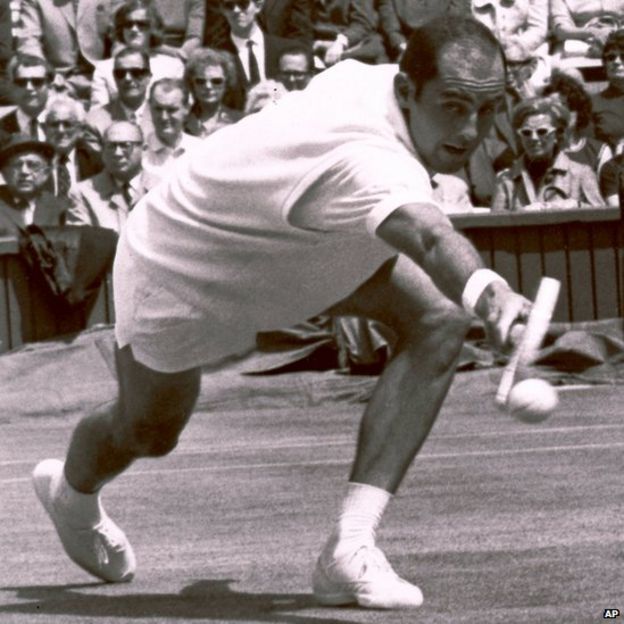
Hewitt, who was a multiple Grand Slam doubles champion in the 1960s and 1970s, is expected to appeal against his conviction and sentence.
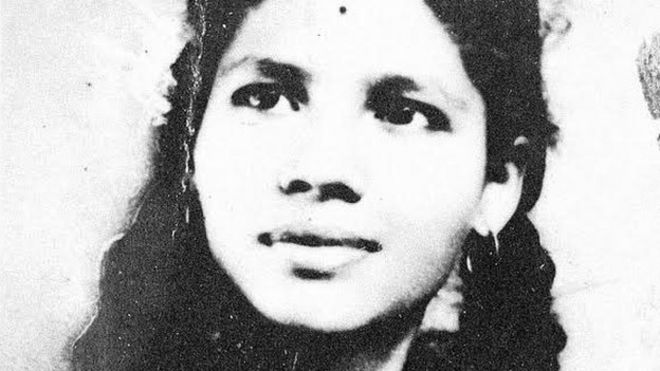
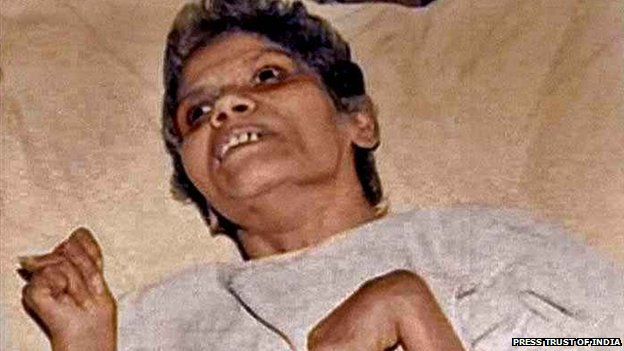
Aruna Shanbaug was 25 years old when she was brutally raped
An Indian nurse who spent 42 years in a persistent vegetative state after being raped and strangled has died.
Aruna Shanbaug was left with severe brain damage and paralysed after the 1973 attack by a ward attendant in the Mumbai hospital where she worked.
She was fed through the nose to keep her alive but developed pneumonia six days ago, the hospital told the BBC.
Her case sparked a debate about India's euthanasia laws. The Supreme Court had rejected a plea to allow her to die.
"Ms Shanbaug died at 08:30am on Monday. She was admitted to the intensive care unit and put on ventilator support," a spokesman at Mumbai's KEM hospital said.
The nurse was 25 years old when she was sodomised by a KEM hospital cleaner who strangled her with metal chains and left her to die on 27 November 1973.
She survived, but spent the rest of her life in hospital, force fed twice a day.
"My broken, battered baby bird finally flew away. And she gave India a passive euthanasia law before doing so," journalist and author Pinki Virani, who wrote Aruna's Story, a book on the nurse's plight, told the BBC.
In her book, Ms Virani described how Ms Shanbaug's condition deteriorated over the years
Twitter reaction: 'Her pain will always shame us'
There is an outpouring of sympathy for Aruna Shanbaug on Twitter. Many feel that she "should have been allowed to go much earlier". Most Twitter users also agree that the absence of the "right to die" in India's legal system compounded her misery.
One Twitter user says Shanbaug's case "represents everything that is wrong with India's society".
Others highlight that she was brutally raped and then had to live in a vegetative state for 42 years because several campaigns in support of euthanasia "just fell on deaf years".
Some say that her ordeal "will always shame India", while others are hopeful that her story will once again reignite the debate on euthanasia.
"Have mostly been ambivalent about euthanasia. But Aruna Shanbaug's case makes me want to take a stand. Misery should not last four decades," this tweet very much sums up the impact her story is likely to have on India's thinking on "right to die".
Ms Virani filed the case which was rejected by the Supreme Court in 2011. She had argued that Ms Shanbaug was "virtually a dead person" and should be allowed to die.
Ms Shanbaug's parents died many years ago and other relatives had not maintained contact with her, Ms Virani said.
She wanted the court to issue instructions to the hospital to stop feeding Ms Shanbaug.
But hospital authorities told the court that Ms Shanbaug "accepts food... and responds by facial expressions" and responds to "commands intermittently by making sounds".
Although the Supreme Court rejected Ms Virani's plea, the case resulted in India easing some restrictions on euthanasia after the court's landmark ruling that life support could be legally removed for some terminally ill patients in exceptional circumstances, providing the request was from family and supervised by doctors and the courts.
Doctors say patients in a vegetative state are awake, not in a coma, but have no awareness because of severe brain damage.
Lawyer Shekhar Nafade, who represented Ms Virani in the Supreme Court, told the BBC that he felt "relieved for Aruna".
Ms Shanbaug's attacker, Sohanlal Bharta Walmiki, was not even charged for raping her since sodomy was not considered rape under Indian laws at the time.
He was freed after serving a seven-year-sentence for robbery and attempted murder.
Ms Virani told the BBC in 2013 that she had tried hard to track him down, but with no success.
"I was told that he had changed his name and was working as a ward boy in a Delhi hospital. The hospital where he had sodomised Aruna and left her in this permanent vegetative condition had never kept a photo of him on file. Neither did the court papers," she said.
Central Waco went into lockdown as police officers began their investigation into the shoot-out
Texas police say 192 people are to face organised crime charges after the Waco bike-gang shooting, which left nine people dead and 18 others injured.
The feud broke out between several gangs at a shopping district in Waco.
What started as a fist fight, soon descended into a battle with knives, clubs, chains and eventually guns.
One witness described the scene as "a war zone", while a Waco policeman called it the most gruesome scene he had encountered in his career.
The incident happened shortly after midday on Sunday at the Twin Peaks Sports Bar and Grill in a shopping area called the Central Texas Market Place.
Bullet casings, knives, a club, bodies and pools of blood were all found inside the restaurant
Up to five rival gangs got into a fight, apparently over parking space near the restaurant. Diners and staff at the nearby cafe managed to lock themselves in a freezer room for safety and were later escorted off the premises by armed police.
In addition to announcing the large number of arrests, Waco police department said on Monday they had temporarily closed the Twin Peaks restaurant for at least a week "due to the ongoing danger it presents to our community".
The authorities have increased security in the area to prevent further outbreaks of violence amid fears some of the gang members might return.
Police spokesman Sgt W Patrick Swanton said preliminary findings indicated that a dispute broke out in a bathroom and eventually spilled over into the restaurant car park.
"I was amazed that we didn't have innocent civilians killed or injured," Sgt Swanton said.
"In 34 years of law enforcement, this is the most violent crime scene I have ever been involved in," he added.
Seven people have been killed when a bus and a truck collided head-on at Manhari-3 of Makwanpur district on Monday.
A bus (Na 5 Kha 3696) en route to Narayangadh from Birgunj collided with a truck (Na 4 Kha 5765) coming from the opposite direction, killing six people on the spot and one in course of treatment.
According to Makwanpur District Police Office, 27 people have sustained injuries in the accident.
The government has decided to mobilise volunteers, authorities and members of the general public this Saturday to clean up Kathmandu city by removing the rubble and debris of collapsed and damaged buildings.
As a part of the Bagmati Cleanup drive, which has been organised every Saturday since May, 2013, the Office of the Prime Minister and Council of Ministers have directed all government authorities, including the secretaries and staff of various ministries, to take part in the cleanup campaign. The drive, which will focus on removing the rubble and remains of the destroyed and damaged infrastructure and buildings will be led by Chief Secretary Lila Mani Poudel.
According to Poudel, the cleanup drive, which will focus on 17different places inside the Valley, will be led by government secretaries from different ministries and will take place between 7 am and 10 am. Beside the government officials, security personnel representing the Nepal Army, Nepal Police and Armed Police Force, along with local communities--including the campaigners of the Bagmati River Cleanup drive--will attend the event.
During the event, the collected debris from private properties will be managed properly and stored in places designated by the property owners. Similarly, the ruins of government-owned buildings and public areas will be stored in their premises. The team will also dump some of the debris in open spaces in and around the city.
The Prime Minister's Office has appealed to all the concerned partners, including the private sector, non-governmental organisations, civil society and local communities to take part in the cleanup drive.
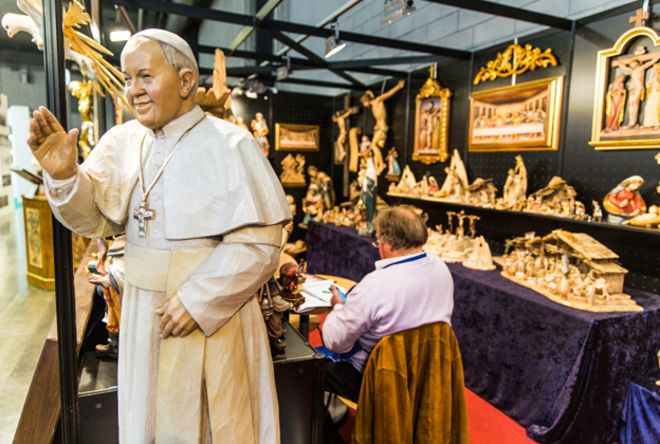
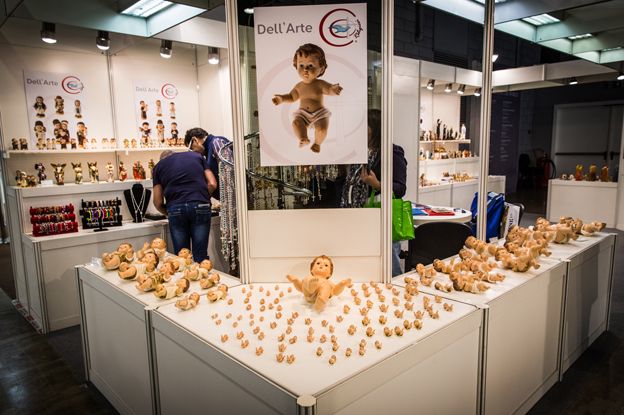
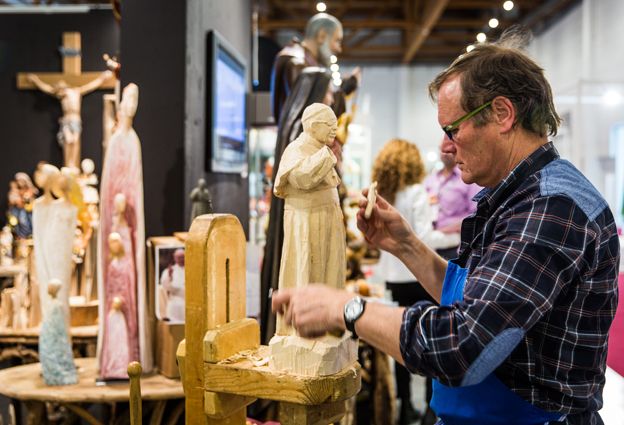
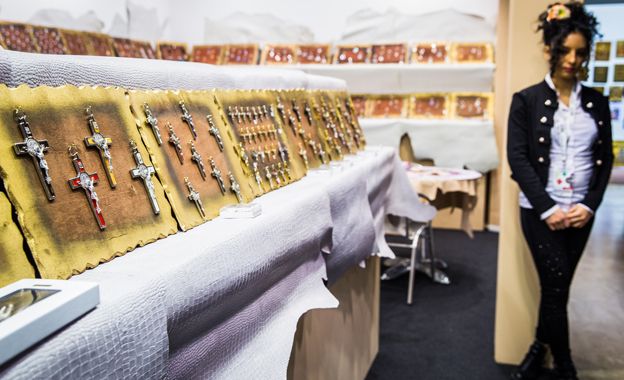
Every two years, in the little Italian town of Vicenza, merchants gather for the biggest religious fair in the world. Vestment producers, sculptors and rosary sellers satisfy a growing demand for religious articles, from Pope Francis fridge magnets to devotional candles, a business that generates billions in Italy alone.
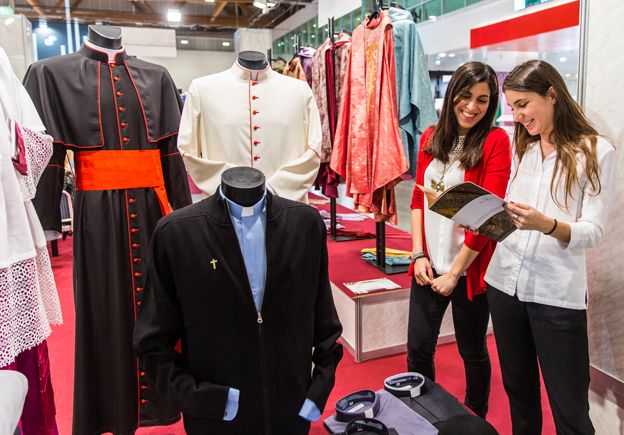
It's 08:30 in the morning and muscular workers are unloading trucks full of boxes marked "Fragile", clothes wrapped in tissue paper with "New collection, 2015" written on the hangers are being carried into the exhibition centre, and young women in miniskirts and stilettos are rushing around getting things organised.
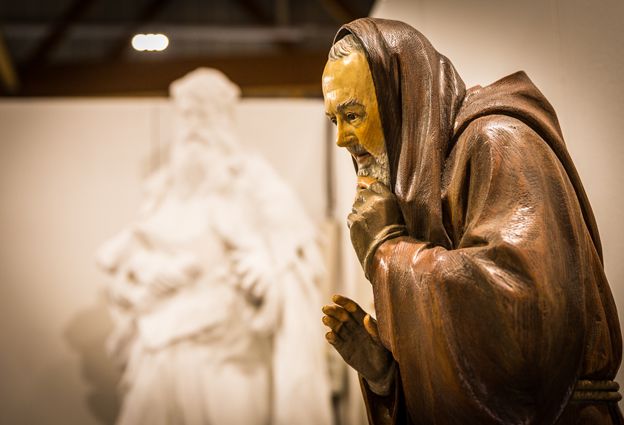
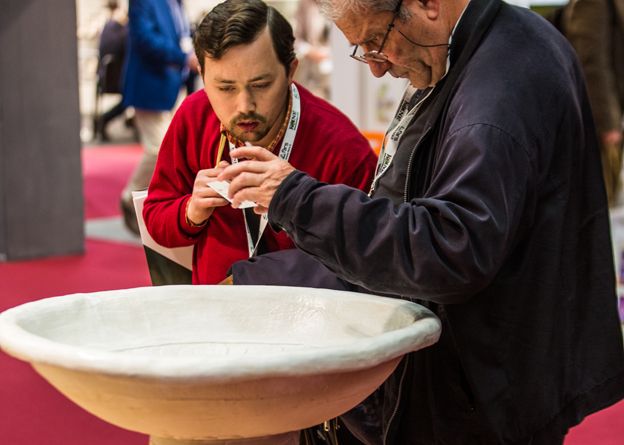
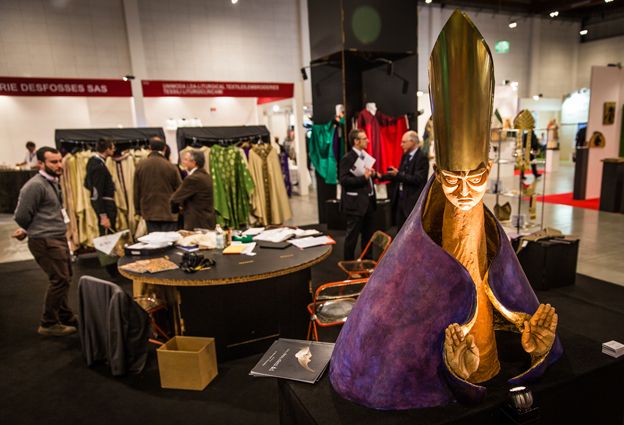
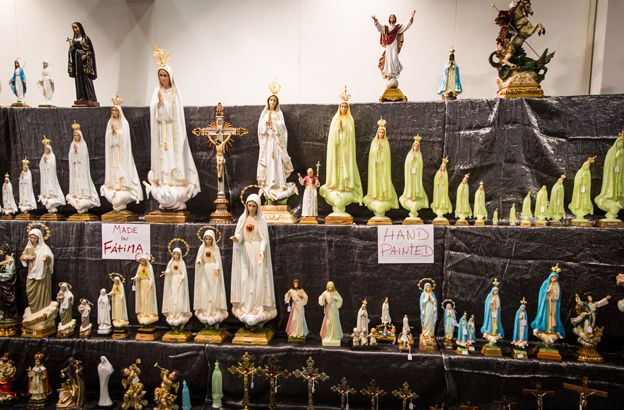
But when church bells chime the hour and the doors open, we enter what some might take to be a priest's version of Heaven, filled with life-size statues of Mary, every possible type of holy water sprinklers and the very latest collection of cassocks and tunics.
Once every two years Catholic clergy from the four corners of the world come to Vicenza to buy church supplies, learn how to enhance their liturgy or just to renew their wardrobe.
Father Pasquale has travelled 13 hours by train from his parish in Calabria to check the new trends in sacred merchandise. With a little pad and a camera, he roams around the 15,000 sq m of the fair, furiously taking pictures. He doesn't have much time - he has to catch the train home in a few hours to report back to local chaplains.
"I wouldn't miss this fair for anything in the world," he says. "It's a bit of a hassle, that's for sure, as I spend more time on a train than anything else, but it's important for us - humble priests in southern Italy - to see how the Catholic church develops, what's new in terms of technology that would make our lives easier and to check what priests from big cities wear and how they perform the liturgy."
Other parishes in Calabria chipped in to cover his travel expenses, and he tries to get the best deals.
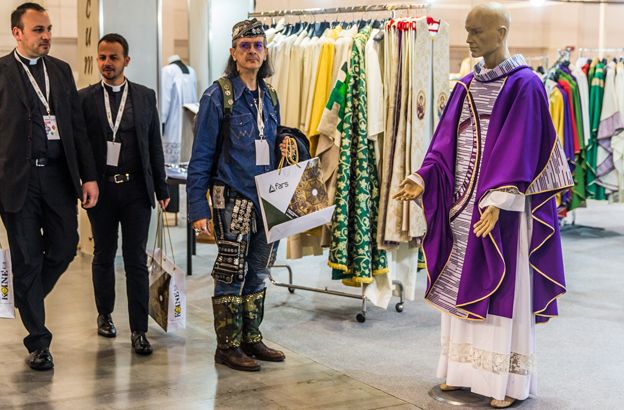
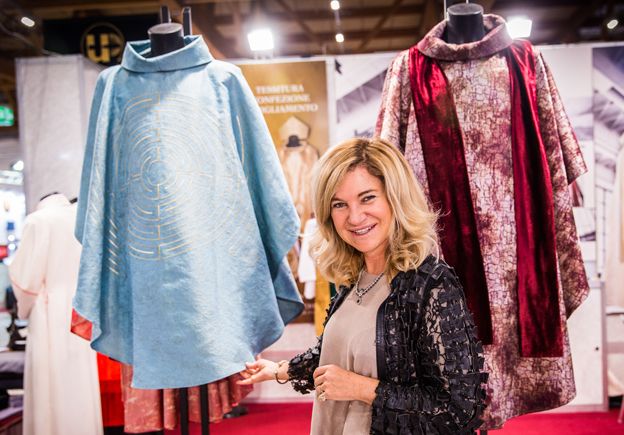
Father Pasquale suddenly stops and wonders in front of a stand that displays light blue vestments embossed in silk velvet and gold laminated prints, his eyes filled with amazement and joy. He reaches to feel the fabric with his fingertips and hums with delight. "You have Armani, Gucci or Prada," he says. "This is our version of haute couture."
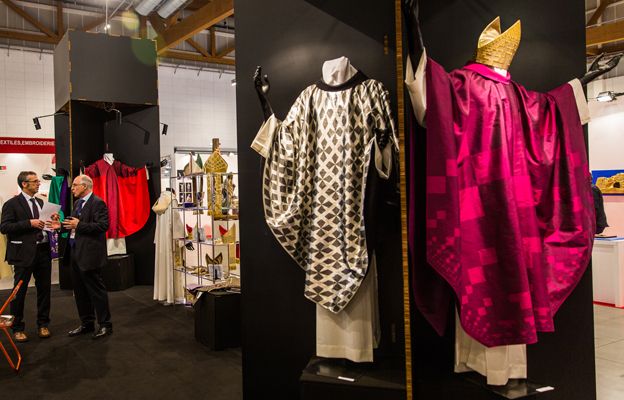
The stand belongs to the Bianchetti family, Italy's leading supplier of ecclesiastical clothing - its clothes, the joke goes, are prete-a-porter, a pun on the Italian for "priest" and the French for "ready to wear". The head of the company, Elisabetta Bianchetti, personally designs and produces each and every vestment in the collection.
"Through the years we have manufactured pieces of clothing for three Popes: John Paul II, Benedict XVI and now Pope Francis," she says. Meanwhile, her daughter talks Father Pasquale through the 2015 collection, which was apparently inspired by 1960s fashions. "We are always in search of new inspirations that will drive sacred fashion forward," she says.
Ecclesiastical clothing in Italy is a £18m ($27.4m) annual business, but Bianchetti's vestments do not suit every budget with prices for a tunic ranging from £400 to £1,300 ($600 to $2,000). The Bianchettis say they clothe "top clergymen from around the world", who want the best - a combination of tradition and "original Italian fashion".
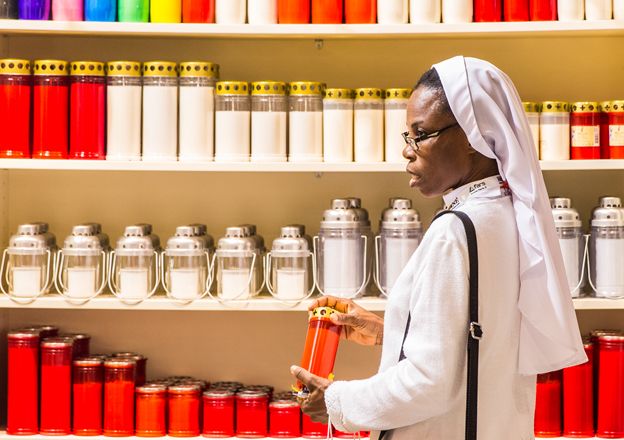
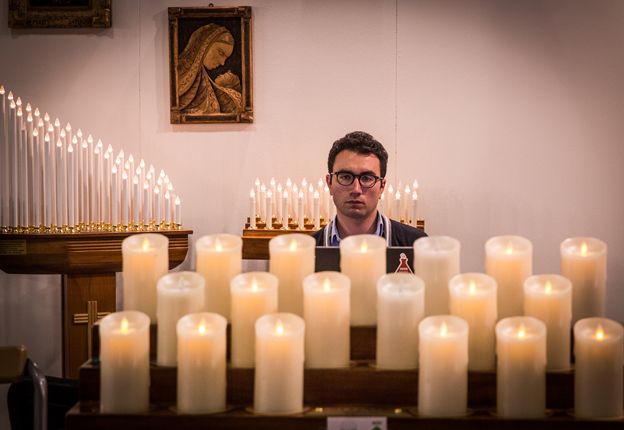
During his tour, Father Pasquale stops a couple of times at a stand that sells devotional candles. "They look like normal candles from afar and they are made of wax but, to my surprise, they are powered by electricity," he says. The producer, Danilo De Gaspari, came up with this idea for his parish near Milan a couple of years ago and now he's exporting his product around the world, to countries such as India and Brazil.
"Churches across Italy are pretty old and fire represents a serious hazard for worshippers. What we came up with is a wax candle with an LED inside. When you insert the coin in the machine, the LED lights up and a little magnet makes the plastic flame-shaped component on top of it wiggle. Parishes save money and they eliminate the risk of fire."
Father Pasquale is impressed but not entirely convinced. "I like the act of lighting a candle myself to be really honest," he says.
Others, from India and the US, are placing orders. "We can set the candles' timer to 20 seconds so the parish in my home town can make a little money out of it and we can finally afford to renovate the house of worship," says Labham Sogani, a trader visiting from Delhi.
The overall religious goods business in Italy is estimated to be worth something like £3.4bn ($5.2bn) - more than the country earns from exporting wine. And a year-long "extraordinary jubilee" called by Pope Francis, which is due to start in December, provides opportunities for growth.
As I talk to religious merchandise businessman Rocco Ascione, we are frequently interrupted by the ringing of his mobile phone. "They constantly call me from various shops in Rome, they place orders every waking hour because they're afraid to run out of Pope fridge magnets or pens with the image of the Holy Mary when the chaos begins," he says.
The Vatican will be visited by millions of pilgrims during the jubilee year and like any businessman, Ascione wants to capitalise on this opportunity. "Worshippers would spend any amount of money for a Jubilee souvenir," he says. "It's a business like any other, but this is more special: this is blessed by God."